
Choose Your Response
Jul 18, 2026
By Brooke Long, Founder & Executive Coach, Thrive – Do What Matters · Updated July 2026
Response-Ability is your capacity to choose a resourceful response instead of an automatic reaction - the moment between something happening and how you act on it. This article walks through simple, brain-based, techniques for building Response-Ability: creating calm, considering the story, building positivity and practicing gratitude.
Regardless of whether you lead people, or yourself, you've no doubt had a moment where your reaction didn't match your intention. The sharp reply made before thinking it through. A decision stemming from frustration rather than clarity. Micro-management in place of curiosity. These moments aren't character flaws or ingrained personality traits - they're simply biology.
Your reactions are your Response-Ability
Leadership is a human endeavour, which means it isn't executed perfectly. Sometimes we react in the moment and then regret our response. When that starts happening as a pattern, there's a problem - because as a leader, your reaction is your Response-Ability.
In times of uncertainty and change, a team takes its cue from their leader's steadiness.
If you're developing a pattern of
unresourceful or unpredictable responses, learning to manage your brain will improve your leadership effectiveness.
What's happening in your brain
Every event you experience triggers your brain to create an internal representation - a picture of what you believe has happened. You respond accordingly, and every response you give has an impact on your results, your relationships, your well-being and the people around you.
🧠Your brain is wired for speed, not accuracy. Your amygdala, the part of your brain that processes emotions, doesn't pause to ask whether an urgent email is actually an emergency, or whether a delay in a project timeline is a genuine attack. It just responds.
Psychologist Daniel Goleman originally named this pattern, the "amygdala hijack": an intense emotional reaction that overrides rational thought before the rest of the brain can weigh in. He has since rephrased it to be "an emotional hijack", recognising that the amygdala works with other brain-circuitry to direct our attention and fixate on the things that we perceive as upsetting, distressing or threatening.
In these moments, emotion drives decision-making before logic has time to engage. You feel first and think second, which means the quality of your response is directly shaped by the quality of your state. And if that state is rooted in fear, you're no longer leading from your values - you're leading from your nervous system.
That can lead to unresourceful responses, both internal and external: over-reaction, anger, procrastination, blame, catastrophising. Over time, these patterns can reinforce the perceived danger, making your brain even more reactive in future.
Take a breath!
When your threat response is activated, your body releases a burst of stress chemicals like adrenaline and cortisol. Pausing for a short period while that initial surge settles calms your nervous system, reassures your brain there is no real danger, and creates the opportunity to respond resourcefully rather than reactively.
Take action: When you notice a triggering event, start making a difference by building in a pause. Breathe in for two seconds, hold for two seconds, breathe out for two seconds. Picture yourself on holidays. Recall the smell of your favourite food. Remember the face of someone you love. This pause allows the initial neurochemical burst of an amygdala hijack to dissipate and gives logic a chance to catch up to emotion.
⏸️ Breathe in for 2, hold for 2, out for 2.
Ask: What story am I telling myself?
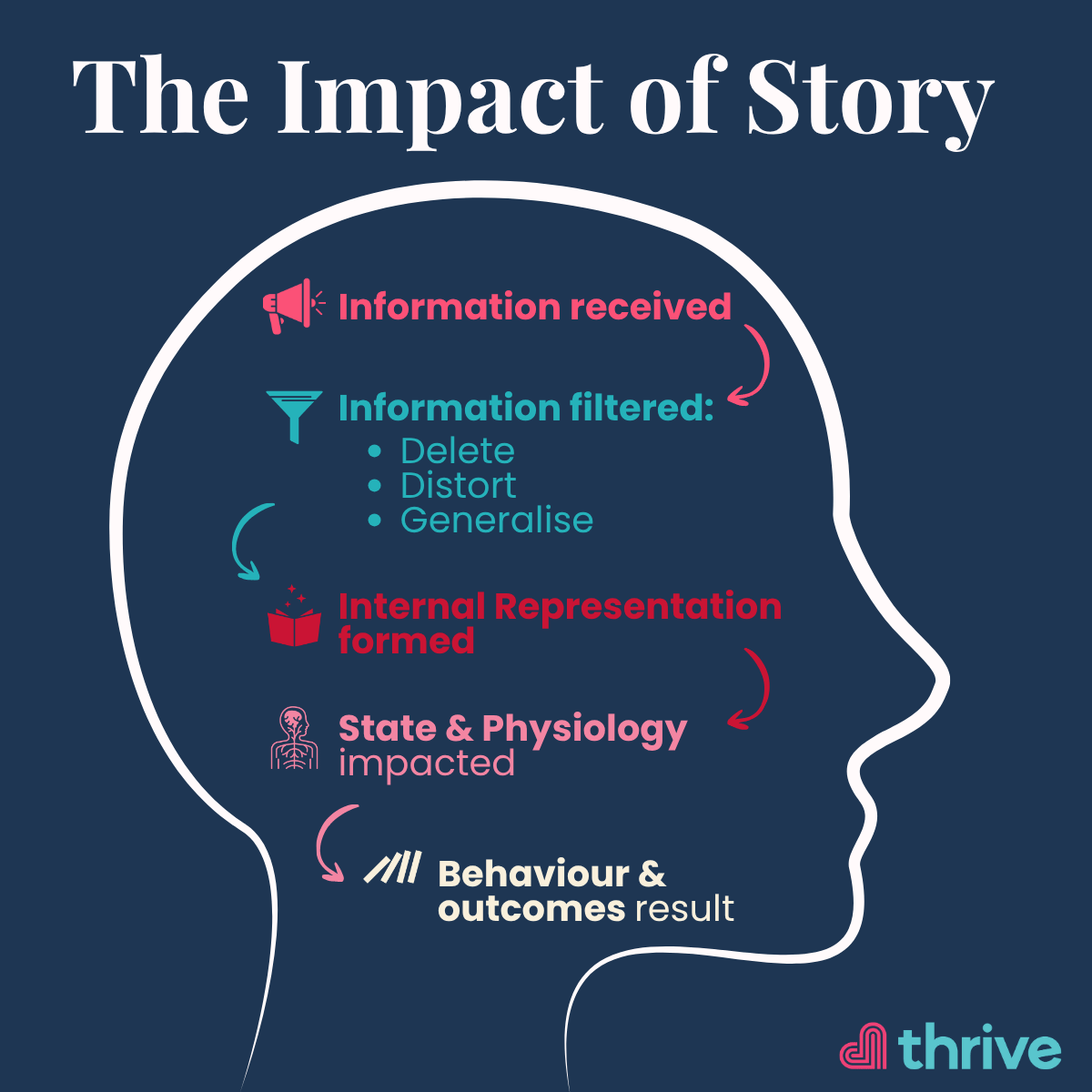
As your brain processes information to form your internal representation, it filters what it takes in - generalising, deleting, distorting. Those filters are shaped by your existing beliefs, memories, experiences and stories, which is why two people can experience the same event and interpret it completely differently.
Imagine you're a sales leader, surrounded by news of the challenging economic times and cost of living crisis. You start telling yourself - "the market is quite challenging now" and suddenly that becomes the filter for your thoughts.
Your RAS, Reticular Activating System, goes to work finding proof that validates your story. And so your brain filters delete the hesitant buyer who perhaps just needs a chance to consider their decision. It distorts a quiet room as a disinterested one. You generalise one quiet week to be indicative of the whole quarter.
Our filtering process shapes our internal representation and impacts our physiology, which in turn impacts our behaviours. All in the blink of an eye. Recognising this process happens helps us become aware that our responses are being impacted by a lifetime of existing thoughts and behaviours - which may not be serving us resourcefully.
We learn to pause, to identify an unresourceful story and challenge it. 🙅♀️
Take action: After pausing, ask yourself - "What story am I telling myself about this?". Is this a story that serves me, a message I want my brain to reinforce? Consider - is there another, more positive meaning, I could give to this?
Double down on positivity and gratitude
Finding alternative meanings for the stories we tell ourselves becomes easier the more positively we think.
Positive emotions widen a Leader's cognitive field, helping to broaden their perspective and ability to find better solutions, think more creatively and engage collaboratively.
Barbara Fredrickson's Broaden-and-Build theory revealed the impact of consistent positivity. People who repeatedly access positive emotional states build psychological resources they can then drawn on when difficulty arrives. They are better equipped to identify possibility and opportunity, and Choose their Response accordingly.
Take action: Finding ways to build positive emotion as a Leader helps you, and your team, to both feel better and think better. Some simple ways to build positive emotion are:
😶🌫️ Manage your own state. Remember - your emotions are contagious and shape the environment your team operate in.
👏🏻 Provide genuine recognition, regularly. Consistent, timely and specific acknowledgment of behaviours (moreso than results) boosts engagement.
🩷 Start meetings with a good news story or by asking others to share something that's gone well in their day. This shifts the quality of thinking in the room before the meeting even gets started.

The gap between stimulus and response is where our ability to Choose Your Response lives, and it widens with self-awareness when we identify what's happening and name our emotions, calm our nervous system and reframe limiting beliefs or stories with an alternative meaning. Strengthening self-awareness is therefore essential to building Response-Ability, and a daily practice of reflection is one of the most effective paths to achieve this.
Consistent gratitude and reflection practices have been linked in neuroscience research to reduced amygdala reactivity and increased activity in the prefrontal cortex, the brain region responsible for regulated decision-making. In this way, a consistent gratitude practice supports clearer thinking and better decision-making. It can physically build the neurological conditions that support us to pause and choose our response in times of pressure and stress.
Take action: To build gratitude and reflective practices, start simply. Build one deliberate pause point into your daily routine. Before your first meeting, or at the end of your day, take five minutes to reflect. What's improving? Who can you be grateful for? What are you learning?
This small but mighty step helps to increase your self-awareness and strengthen your Response-Ability.
The Thriving Take Away
Building Response-Ability does not require a personality overhaul. First and foremost it requires awareness - of what is happening in your brain, of the stories shaping your filters, and of the daily practices that strengthen your capacity to pause before you react. Create calm first. Challenge the story next. Build positivity and gratitude as consistent practices, not occasional ones. Those steps, repeated over time, are what shift an automatic reaction into a deliberate response.
What's Next
 This article is a starting point, with techniques to help you start widening the gap. Strengthening your ability to Choose Your Response develops with consistent practice, the right tools, and the right support.
Want to go deeper? Download our free companion guide, Choose Your Response: A Practical Guide to Building Your Response-Ability, for the full framework with guided reflection exercises you can work through at your own pace.
At Thrive – Do What Matters, we offer personal, business and executive coaching that provides the support to build self-awarenss and Response-Ability. We blend evidence-based frameworks with a holistic, personalised approach to equip you with the mindset, tools and systems to create lasting growth.
Book a free Discovery Call and let's talk about what personalised coaching support could look like for you.
Frequently asked questions
What is response-ability?
Response-Ability is the capacity to consciously choose how you respond to a situation, rather than reacting automatically. It lives in the gap between a triggering event (the stimulus) and your behaviour (the response). That gap widens with self-awareness and shrinks under stress.
What is an amygdala or emotional hijack?
An amygdala or emotional hijack is a term coined by psychologist Daniel Goleman to describe an intense, disproportionate emotional reaction that overrides rational thought. It happens when your brain's salience network responds to a perceived threat before the more logical, reasoning part of the brain has a chance to engage.
How do I stop reacting emotionally in the moment?
Pause before responding. Slow, deliberate breathing (in for two seconds, hold for two, out for two) helps calm the nervous system while the initial stress-chemical surge settles, creating space for a more considered response instead of an automatic reaction.
Can you actually train yourself to respond better under pressure?
Yes. Response-Ability is a learnable skill, not a fixed trait. Practices like structured breathing, examining the internal "stories" you tell yourself, deliberately reframing unhelpful narratives and regular gratitude reflection have all been associated with reduced reactivity and stronger emotional regulation over time.
Does gratitude practice really change how your brain responds to stress?
Research suggests consistent gratitude practice is associated with measurable changes in brain activity. This includes reduced amygdala reactivity and increased engagement of the prefrontal cortex, the region involved in decision-making and emotional regulation.
SOURCES
- Goleman, Daniel; Emotional Intelligence
- Goleman, Daniel; Emotional Intelligence, Emotional Hijacks, and Systems Thinking
- Fredrickson, B.L. The Broaden and Build Theory of Positive Emotions, Philos Trans R Soc Lond B Biol Sci., 2004 Sep 29
- Emmons, R. A., & McCullough, M. E.; Counting blessings versus burdens: An experimental investigation of gratitude and subjective well-being in daily life. Journal of Personality and Social Psychology, (2003) 84(2), 377–389.