
The Accountability Gap: How to Build a System That Actually Works
Jul 14, 2026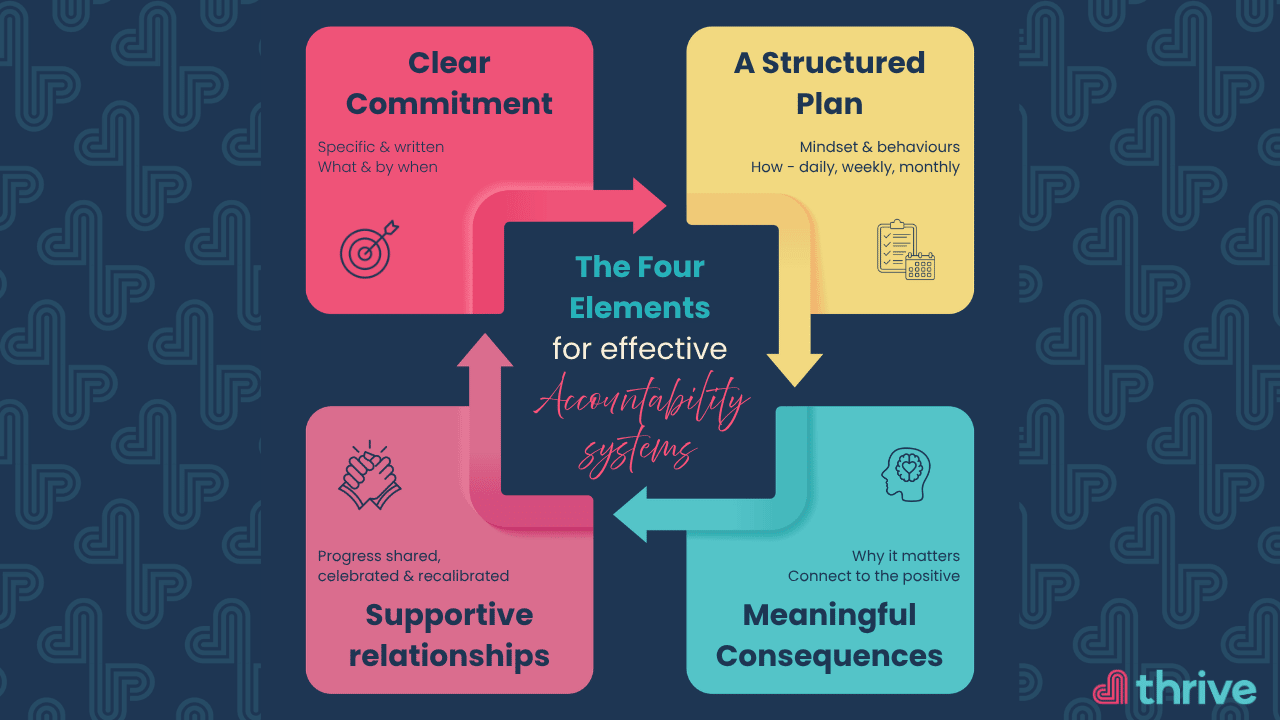
By Brooke Long, Founder & Executive Coach, Thrive – Do What Matters · Updated July 2026
The accountability gap in performance is the space between establishing desired outcomes, and actually following through on them - being ABLE to COUNT on yourself to take action. That gap is not closed by simply "trying harder". Instead, it's closed by building a system with four specific elements: clear commitment, a structured plan, meaningful consequences and supportive relationships.
This article explores how Leaders can establish an effective accountability system, learn to spot the blind spots that can derail progress and harness the secret sauce to helping teams acheive their goals.
Commitment or compliance?
As Leaders, whenever we consider the outcomes our team are working towards, whether collectively or individually, one of the first questions we should ask is "why will progress happen?". Will action occur because your team want to do the work, or because they feel they have to?
That distinction between commitment ("I want to do this") and compliance ("I have to do this") is critical for building a team that sustains performance over the long run, not just the first few weeks of a new plan or promotion.
Decades of research in self-determination theory, led by psychologists Edward Deci and Richard Ryan, shows that people who act from intrinsic motivation demonstrate stronger persistence, better wellbeing and higher performance than those driven by external pressure alone. Yet Gallup's 2026 State of the Global Workplace report found only 20% of employees globally are engaged. The other 80% are, at best, complying.
Compliance can look like effort, but often it comes to a standstill as soon as pressure, oversight or focus is reduced. Commitment, on the other hand, means progress continues because your team member has taken ownership of the work.
You can help your team take ownership, by asking:
- Have I connected the work to their why? Not the company's strategic plan, but the team member's individual purpose. When someone can relate their work to their own goal, ownership follows.
- Am I telling or asking? "Here's what I need you to do" builds compliance. "What do you think would work here?" builds the autonomy that fosters intrinsic motivation.
- Am I only recognising results, or effort too? In recognising indicators of autonomy like proactivity, initiative and commitment, you reinforce and celebrate individuals owning their own outcomes.
If you suspect an accountability gap in your team's work, perhaps question whether you're building commitment, or just compliance? The former comes from coaching and strengthening accountability behaviours, the latter from pressure - and pressure has a short shelf life as a strategy for sustained performance.
Building an accountability system
Although commitment outperforms compliance, it still needs to be sustained. For Leaders, that's where accountability comes in - not as a single conversation, a KPI or "a stick", but as a behaviour you help your team build. And, like any behaviour, it is best built and strengthened with a system.
An effective accountability system comprises four elements and can be used Leaders personally, for individual team members or for team goals as a whole:
1. Clear commitment
Vague goals produce vague results. Research by Dr. Gail Matthews at Dominican University of California found that people who wrote down their goals were significantly more likely to achieve them than those who only thought about them. This first element of an Accountability system leverages that understanding and requires the goal or outcome to be written, with specific details, describing exactly what you, your team or team member are committing to do, and by when?
2. A structured plan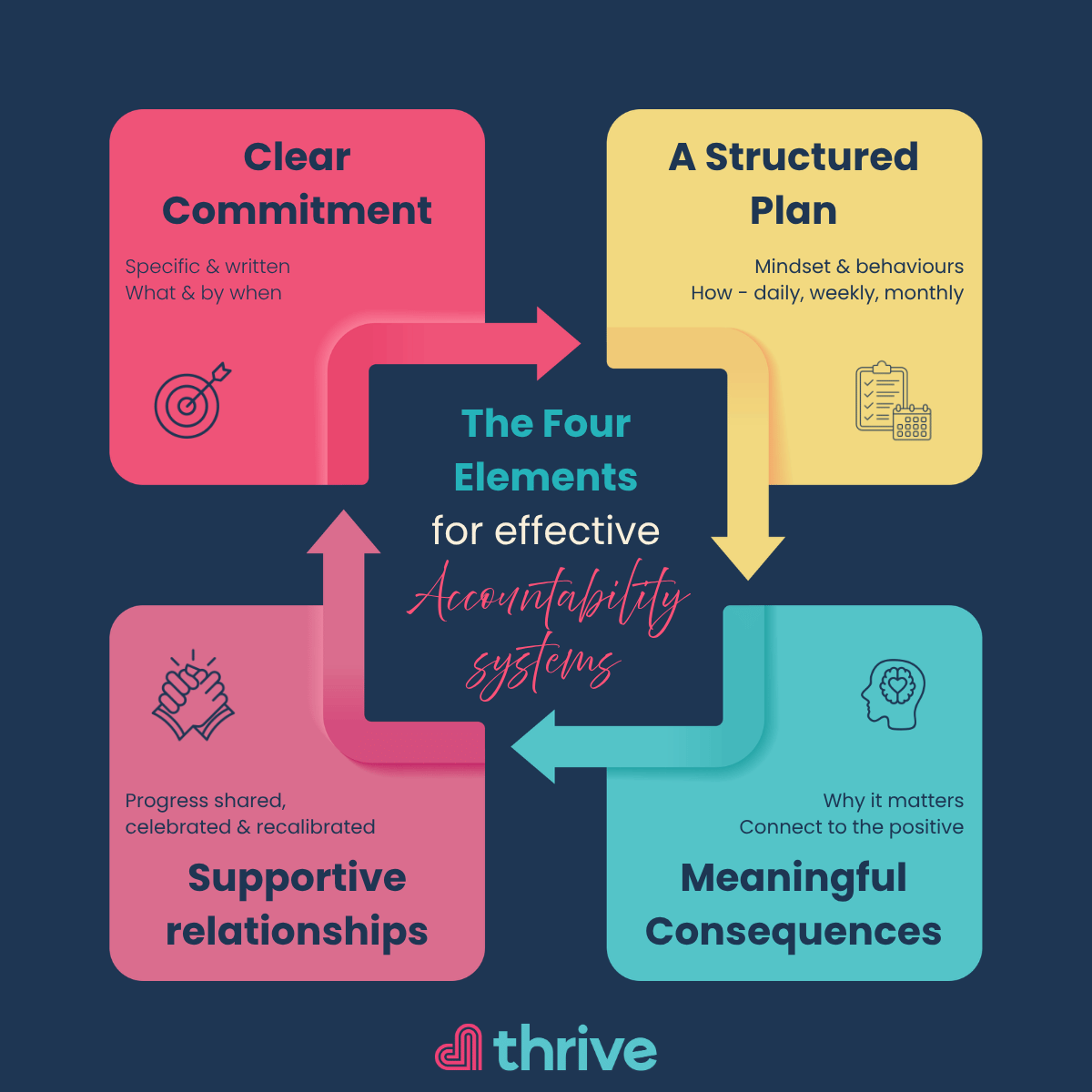
A commitment without a plan lives entirely in the realm of intention, as does a plan that isn't protected in your schedule. Ask what mindset and behaviours are needed to make the commitment happen, then break the plan into daily, weekly and monthly actions. This is the power of combining the Be + Do = Have framework with the Priority Matrix - the question isn't only what you'll do, but how it's built into your week.
3. Meaningful consequences
Identify what is gained by following through, and what is genuinely lost if achievement doesn't occur. Make the cost of inaction visible and real, and build connection to the positive consequences. Then, to strengthen commitment rather than compliance, reinforce those positive consequences as progress is made.
4. Supportive relationships
Matthews' research also found that people who sent regular progress updates to a supportive person had higher success rates than those who kept their goals private. Accountability in isolation is variable and fragile. It strengthens with the right support structure in place. As a Leader taking the role of an Accountability partner, remember your involvement extends beyond a simple "check in". It requires a deliberate assessment of progress, recalibration where appropriate and recognition of effort and achievement.
Most accountability efforts fail because either the system doesn't exist, or it's missing one of these four elements. To assess your own system, personally or for a team, ask:
- How are commitments recorded?
- How are they transformed into a structured plan, with consideration given to the mindset and actions needed to succeed?
- How are positive consequences reinforced along the way?
- How is progress shared, celebrated and recalibrated?
Improving these four elements can strengthen your accountability system and improves how we, and others, can count on our ability.
What if action doesn't happen?
Somtimes, despite having the goal, the plan, the system, and every good intention in the world in place, the follow-through doesn't happen.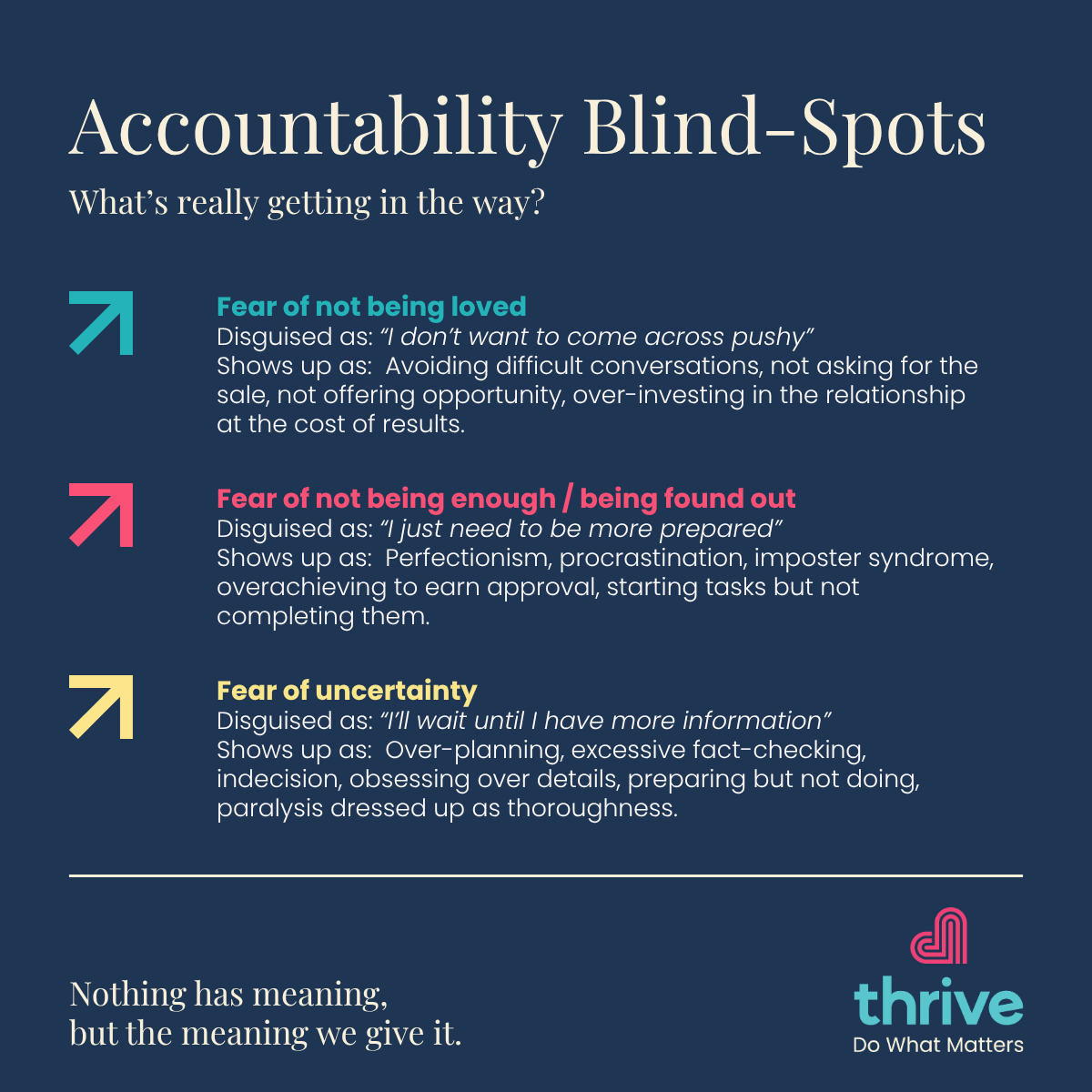
In these situations, often the person responsible for action is being held back by their thinking. Their brain has found a comfortable excuse and presented it as entirely reasonable - "no one wants to buy right now, it's not a good time to ask" or "I'll wait until things settle down.".
That comfortable excuse is an accountability blindspot: a pattern that consistently blocks progress, disguised so well it seems plausible. It's almost always built on False Evidence Appearing Real - FEAR.
Three fears commonly sit behind accountability blindspots:
💔 The fear of not being loved - showing up as avoidance, people-pleasing, sidestepping anything that risks rejection.
😰 The fear of not being enough - showing up as perfectionism, procrastination, imposter syndrome. Waiting to feel ready rather than starting.
⁉️The fear of uncertainty - showing up as over-planning, excessive checking, difficulty deciding. Paralysis wearing the costume of thoroughness.
Fears are simply behaviours we've accepted as true, because our brains have learned over time to trigger the false evidence and present it as truth. The behaviour doesn't arrive announcing itself as a fear - the disguise is the point.
The first step to unlearning the behaviours underpinning an accountability blindspot, or helping a team member unlearn them, is the same as checking a blind spot while driving: awareness. Consider the reason action isn't progressing, then challenge that reason. What's really getting in the way?
Once we check the blind-spot and become aware of the obstacle, then we can respond.
From a leadership perspective, gaining awareness of the real challenges opens up powerful coaching opportunities that can dramatically shift someone's behaviour. Imagine the team member who's work is constantly behind - not because they're slow to move but because they're caught in over checking details, afraid of getting things wrong and being exposed as an imposter. Helping them to chunk work into smaller milestones, providing opportunities for feedback and reinforcement, not only progresses the work you need completed but strengthens their abilities to perform ongoing.
Two messages are critical In helping team members identify and challenge accountability blindspots:
- The reassurance that everyone has a blindspot; and
- The acceptance that the blindspot may derail us repeatedly, but we can learn to anticipate it and reduce its impact by planning to fail.
Plan to fail
There's a strange gap in how most goals or targets are set. A transformation project gets a risk register, a sales strategy gets a contingency plan. However, everyday personal progress is assumed to just happen on schedule.
Realistically, it's highly likely to be derailed - whether by an accountability blindspot, a communication breakdown, or most commonly - life.
Those who sustain personal performance over time aren't somehow immune to life. Things still happen that take them off track, but there's every chance they have decided in advance how they'll respond when things don't go to plan.
Teresa Amabile and Steven Kramer's Progress Principle research found that progress in meaningful work, not perfect execution, was the single biggest driver of motivation, creativity and performance. Even small, imperfect forward movement sustains momentum.
This is the logic behind planning to fail: plan for the reality that something will get in the way, and decide in advance how you'll respond when it does so you can continue to progress forward.
- Build an if/then response. "If I find myself procrastinating, then I will take the smallest step and work on it for 10 minutes." Deciding this in advance removes the decision from the moment.
- Plan for course correction through regular reflection. What went to plan, what didn't, how to adjust. Recalculate the route rather than abandon the trip.
- Manage your self-talk. Reframing how you define progress with positive inner language supports consistency and builds momentum.
Progress over perfection isn't a consolation prize. It's a deliberate strategy and Leaders' helping their team plan to fail by asking the question "What could get in the way for you" is key to building that strategy.
Going together
The premise beneath the Accountability system is that goals are shared. A team's work relies on each team member to play their part.
In April 2026, we were reminded of what can result from incredible leadership and teamwork when the crew of Artemis II successfully completed NASA's first crewed lunar fly-by in over 50 years.
Their success served as a reminder of the power of going together, and the importance of having someone who'll hold your dream, support you to achieve it, challenge you, keep your accountable to your commitment. The Accountability partner who helps uncover the blindspots, to remind you of the plan for when things de-rail, refresh your commitment.
Dr. Matthews' research backs this up directly: participants who wrote down their goals, formed action commitments, and sent weekly progress reports to a supportive person achieved substantially higher success rates than those who only thought about their goals privately.
Accountability compounds when it's shared. And as busy Leaders, juggling many balls, it can be easy to underestimate the impact we can have as our team's Accountability partner. 1:1s and check ins get rescheduled, or the Work In Progress meeting is just a quick run through to save time focusing only on the urgent topics.
As a leader keen to step fully into the role of Accountability partner, and develop your team individually and as a whole, identify your next steps by considering:
🎯 Who in your team is working toward a meaningful goal without a structured support relationship? What would change for them if that existed?
💭 What does accountability look like in your culture when things go well - and when they don't
🩷 For yourself: who holds the standard with you? How do you role model for others the benefits of working with an Accountability partner?
The leaders who consistently deliver excellence, and grow the people around them, understand that going together is faster, more sustainable and more effective than going alone. They lean into their role as an Accountability partner.
The Thriving Take Away
Accountability is not a performance expectation, or a conversation you have when things go wrong. It is a behaviour to be built, strengthened, and led. Helping your team to close the gap between intention and outcome is easier when you build an Accountability System with the right elements, help people understand their blindspots and plan for the inevitable moments when progress gets derailed. When you lead accountability that way, and fully embrace the role of being an Accountability Partner, you do not just improve results - you build a team that can count on itself.
What's next
Building real accountability, for yourself or your team, isn't a one-off conversation. It's a system and is strengthened when it's built with the right structure and support.
At Thrive – Do What Matters, we help Leaders build accountability systems and establish effective Accountability Partnerships, using evidence-based coaching frameworks tailored to your individual circumstances.
Book a free Discovery Call and let's talk about closing the accountability gap in your team.
Frequently asked questions
What is the accountability gap?
The accountability gap is the space between setting a goal, or making a commitment, and actually following through on it. It's closed not by willpower alone, but by a system: clear commitment, a structured plan, meaningful consequences, and supportive relationships.
What's the difference between commitment and compliance?
Commitment means someone is doing the work because they want to - it's connected to their own purpose or goals. Compliance means they're doing it because they feel they have to. Compliance looks like effort but tends to stop the moment external pressure does, whereas commitment continues when no one is watching.
What are the four elements of an effective accountability system?
Clear commitment (a specific, stated goal with a deadline), a structured plan (broken into daily, weekly and monthly actions), meaningful consequences (both the cost of inaction and the reward of follow-through made visible), and supportive relationships (regular check-ins with someone who holds the standard with you).
What are accountability blindspots?
Accountability blindspots are the comfortable excuses your brain presents as reasonable explanations for not taking action but are actually rooted in fear - commonly the fear of not being loved, not being enough, or uncertainty. They're hard to spot because they don't feel like excuses; they feel like logic.
Does having an accountability partner actually help you achieve goals?
Yes. Research by Dr. Gail Matthews at Dominican University of California found that people who committed their goals to another person and sent regular progress updates achieved meaningfully higher success rates than those who kept their goals private and unwritten.
SOURCES:
- Deci, Edward and Ryan, Richard; Self Determination Theory and the facilitation of intrinsic motivation, social development and well-being, American Psychologist, January 2000
- Gallup Inc, 2026 State of the Global Workplace report
- Dr Gail Matthews; The Impact of Commitment, Accountability and Written Goals on Goal Achievement, Psychology | Faculty Presentations. 3.
- Amabile, Teresa M. and Kramer, Steve J.; The Progress Principle, Harvard Business Review Press, 2011.