
Know, Like and Trust: How Authentic Influence Earns the Yes
Oct 20, 2026
By Brooke Long, Founder & Executive Coach, Thrive – Do What Matters · October 2026
People say yes to the people they know, like and trust, and your Authentic Influence strengthens each one of those factors.
Know comes when someone feels they understand who you are, and why you do what you do. Like develops from relatability and connection. Trust derives from your credibility, reliability and genuine interest in others.
Know, like and trust are the building blocks of relationships in Direct Sales - regardless of whether the relationship you're building is with a sales customer, or a team member. And the greatest tool to develop each factor is sitting within you: authenticity.
This article explores the origin of "know, like and trust" and how authenticity relates to each one, the point where a lot of relationships get stuck and why, and what the three factors mean from a leadership perspective.
The origin of "know, like and trust"
The phrase "know, like and trust" is everywhere in Direct Sales and Network Marketing. It comes from sales author Bob Burg, who called it his Golden Rule of Networking in his 1994 book Endless Referrals.
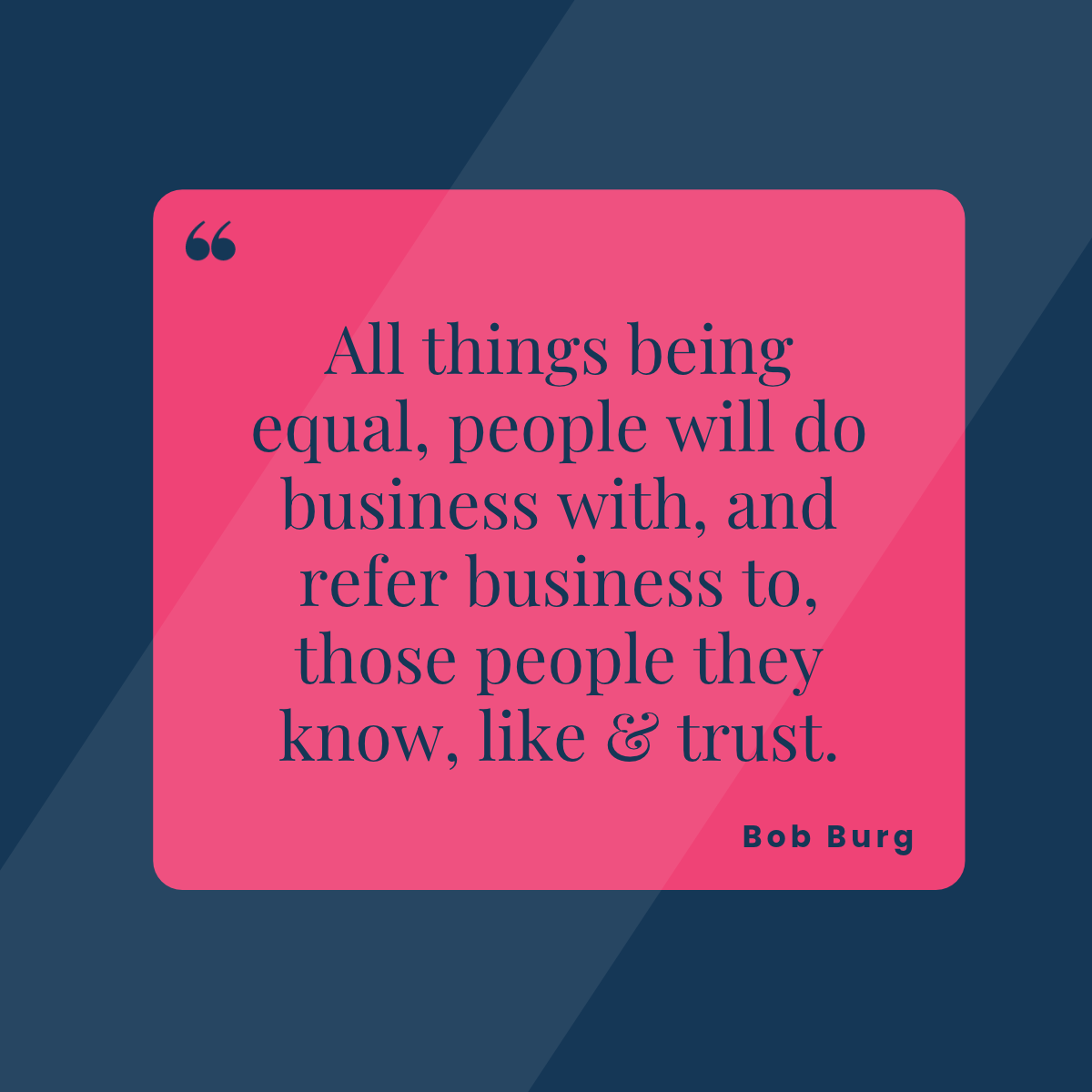 Burg's version starts with a qualifier that is often ignored: "all things being equal". When what's on offer is comparable, people do business with, and refer business to, the people they know, like and trust.
That's why this tenet holds so strongly in Direct Sales in particular - because things are often equal. Your customer could probably buy the same products at the same price from any number of Independent Consultants.
The difference, therefore, is you and how you build those three factors within relationships.
IT'S NOT "AVON CALLING"
From the earliest encounter I had in Direct Sales, I was told - "this is a relationship business". As a bright eyed (complete with blue eye-shadow) new Avon rep, I was given a piece of exceptionally good advice.
The marketing campaign might have been "Avon calling" but creating success on an individual level meant replacing "Avon" with your name. You didn't simply drop an Avon catalogue off at the houses in your neighbourhood and hope for the orders. The key was personal interaction - knocking on the door, introducing yourself, offering the catalogue and your expertise. (Of which, quite frankly, I had none.) The door being opened wasn't just their front door, it was the door to the relationship through the factors of know, like and trust.
That advice to "focus on building relationships" or to "build connections outside of your circle" is the advice Sellers hear consistently. It's helpful direction, but doesn't explain how a relationship actually gets built.
The three building blocks - know, like & trust
Often "know, like and trust" is repeated as one phrase but each element develops separately, in different ways. Understanding the three elements not only helps you to build each one, but can also help diagnostically to recognise where a sales pipeline needs strengthening.
Know: beyond being seen
People might know of your product, they might know your company. But do they know you, as an individual?
Who you are, what your product means to you, the problems you solve and who you solve them for. That context is what brings you to mind and helps you stay in someone's memory.
When a sales pipeline is shallow, we start here with Know - building awareness that extends beyond simply being seen, to being remembered.
Like: rapport and relatability get response
Know extends to Like as a result of rapport building and relatability rather than perfection, or polish. People are drawn to you because you're the kind of person who remembers their daughter started school this year, or that they were about to go on holidays, not the one with the perfect grid of posts.
In their Harvard Business Review article Connect, Then Lead, Amy Cuddy, Matthew Kohut and John Neffinger explain that warmth is the first thing we assess in another person, and that it's the conduit of influence. Warmth is what allows trust to develop.
It doesn't guarantee it, though.
"She's lovely. Everyone adores her." I've heard that sentence from a lot of Leaders describing a team member who is genuinely lovely and adored, and who also has a pipeline of warm connections that never convert. Being liked feels like progress and so often, that's where a Seller will stop building - they think they've established a sufficient connection for the sale to just be a matter of time.
That's not always the case.
Trust: the catalyst for the Yes
Trust is the difference between a warm relationship and the sale. When a pipeline is full of warm leads that don't convert, trust is often the issue. Which is not to say there's distrust, but rather just a lack of proactive trust building.
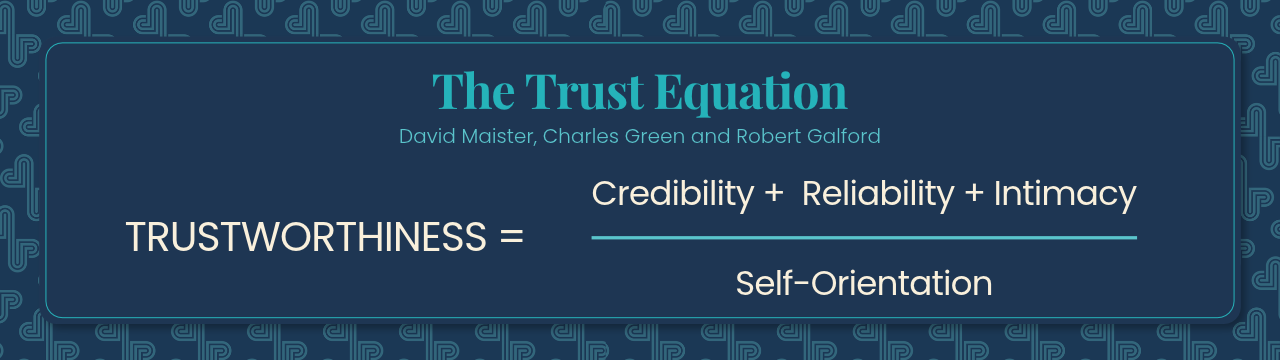
In The Trusted Advisor, David Maister, Charles Green and Robert Galford describe trustworthiness as a formula:
Trustworthiness = (Credibility + Reliability + Intimacy) ÷ Self-orientation
In Direct Sales, we break it down like this:
- Credibility is your product knowledge, your own experience and the expertise your recommendations are based on.
- Reliability is whether you do what you say, when you say. Do you follow up and follow through, consistently?
- Intimacy is how safe a customer feels being open with you based on their assessment of your genuine interest in them and their world.
- Self-orientation is how focused you are on your own outcomes: your target, your promotion, your needs. The higher your self-orientation is, the more it divides the cumulative effect of credibility, reliability and intimacy.
Of the three factors on top, reliability is the easiest to overlook, because it can feel like admin. Customers may not mention reliability, but they notice whether it's forthcoming. The follow up after a conversation to provide information or answer a question. The check in months later that leads first with service rather than sale. The post-sale journey that follows through on your promised benefits and problem solving.
What's encouraging about reliability is that it's the factor easiest to control, and one that provides for proactive trust building. Asking questions that create opportunities for follow up - responding to queries, providing further information of interest, connecting to be of service. These all give you a chance to demonstrate how you follow up and follow through.
Reliability improves with simple systems, like a customer notes file, a calling list and a follow-up approach that makes it easy to identify every week who you need to touch base with to maintain relationships. Relationships are the multiplier of your success, and systems enable the relationships. This principle is so fundamental to success in Direct Sales that it's the one our Evolve Program for Direct Sellers is built around.
The role of authenticity in relationship building
People can't know, like or trust a version of you that isn't authentically you.
That matters more now than it did even a few years ago, thanks to the accessibility of AI tools. "Real" isn't just about your actions, it's about how you show up for others through your words, your images, your collateral.
Researchers at Cornell University found that when people suspected their conversation partner was using AI-suggested replies, they rated that person as less cooperative and felt less connected to them. The suspicion alone was enough to change how they felt.
Why? My sense is that it comes down to safety. When we suspect we aren’t getting the real version of someone, we wonder what’s being hidden, and trust decreases as a result.
Product, Process and Personable
Authenticity doesn't mean leaving your product out - people can't say yes to something they don't know about.
If anything, authenticity means being more transparent about your product.
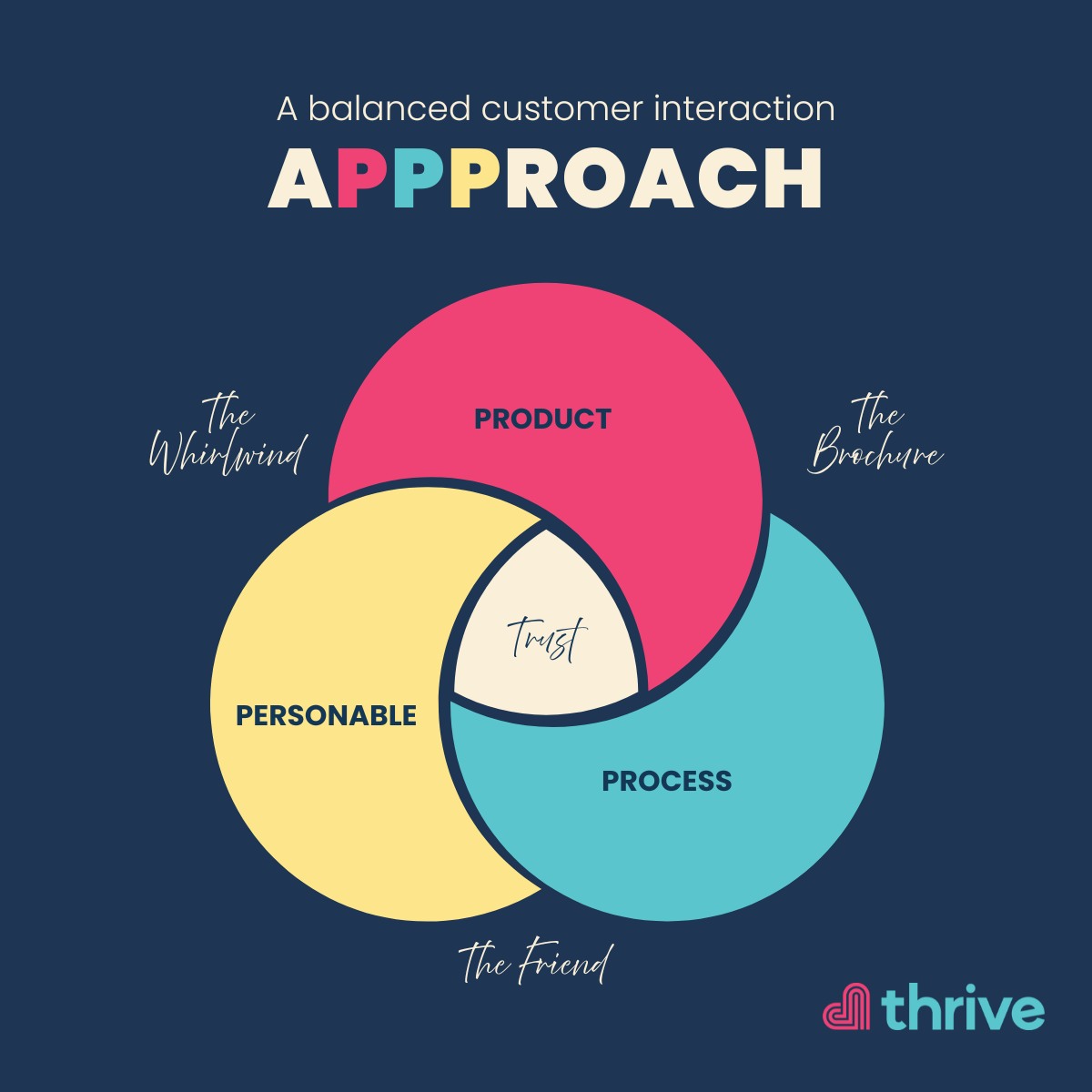
At Thrive we use a simple guide for a Seller's customer APPPROACH, built on three elements:
- Product is what you share: the problems you solve and the possibilities you offer.
- Process keeps you sharing: the systems that help you show up professionally and follow through.
- Personable is how you share: relatable, interested and yourself.
When these three are unbalanced, a pattern often appears:
- Without Personable, you risk becoming the Brochure: accurate and on brand, but forgettable. When you start adding your own voice and experiences into the mix, your relatability and warmth start to shine through and is reflected in customer engagement.
- Without Product, you tend to become the Friend: warm and well liked, but go to ground when it's time to extend the offer. This is the natural habitat for those worried about "being pushy" but when you upskill in bringing the focus back to your product and the problems you solve, results increase.
- Without Process, you can become the Whirlwind: the 30 minute demo that turns into three hours, and the follow-up that never quite happens. By establishing systems and processes, you uncover a treasure trove of outcomes waiting for you.
Trust gets built at the intersection of these three. When you're upfront about your product - what you're selling and why. When you have process in place to be reliable. And when you build rapport, and relatability, through being personable.
Know, like and trust in leadership
In leadership, your customer is your team member. Know, like and trust are the same factors that help your team members say Yes to you.
Yes to interacting with you.
Yes to leaning in to their business.
Yes to engaging in team activities.
Yes to your coaching and support.
Yes to your leadership path.
In Direct Sales, nobody has to follow you - making relationships even more crucial, and know, like and trust essential factors to build.
- Know: Does your team understand your why, and what you stand for when results are tight?
- Like: Do they experience warmth from you before they experience expectations?
- Trust: Do your actions align with your words? Do you follow through on the small promises, like the call back or the resource you said you'd send? Are you genuinely interested in them as individuals?
Your influence rests on whether people want to follow you, and your team decides that much the same way a customer decides whether to buy.
The Thriving Take Away
Know, like and trust are separate factors and each can benefit from deliberate development. Being visible and being liked are wonderful starting points, but require trust to convert to a result - earned through credibility, reliability and genuine interest.
Underneath it all is you - that's what makes the difference when all other factors are equal. The more recognisably you show up, the easier it becomes for customers and teams to know you, like you and trust you. That's your Authentic Influence, and it's the AI that really matters.
What's Next?
This article covers why know, like and trust matter.
The Authentic Influence Masterclass for Direct Sellers goes further into the foundation underneath them: your personal brand, your own stories and the confidence to show up as yourself.
The replay is free to watch, and comes with the Authentic Influence Toolkit to help you put it into action straight away. As a Leader, this is a resource to complete through the lens of how you develop know, like and trust with your "customers" and can also be used as a skill and culture building activity with your team.
Watch the Authentic Influence Masterclass and discover how being recognisably you helps people say yes.
Frequently asked questions
What does "know, like and trust" mean in sales?
It describes the three things people generally need before they buy from someone. Know means they have real context on who you are and what you offer. Like means they feel warmth and connection with you. Trust means they believe what you say and can rely on what you do.
Who said people do business with people they know, like and trust?
Bob Burg, who called it his Golden Rule of Networking in Endless Referrals, first published in 1994. His original wording begins with "all things being equal".
How do I build trust with customers in Direct Sales?
The Trust Equation from The Trusted Advisor is a practical guide. Build credibility by knowing your products well and making recommendations based on your experience and expertise. Build reliability by keeping small promises consistently, ideally with a simple follow-up system. Create intimacy by sharing your own world, by asking questions and listening to understand your customers' challenges and needs. Keep self-orientation low by ensuring your focus is on your customer and their outcomes, not on your own.
How can Leaders build know, like and trust with their team?
The same way Sellers build it with customers. Share your why so your team knows what you stand for. Lead with warmth before expectations. Follow through visibly on what you promise, because your team will model what they see you do.
SOURCES
- Burg, Bob; Endless Referrals: Network Your Everyday Contacts Into Sales, McGraw-Hill, 1994
- Cuddy, Amy; Kohut, Matthew; Neffinger, John; Connect, Then Lead, Harvard Business Review, July–August 2013
- Maister, David; Green, Charles; Galford, Robert; The Trusted Advisor, Free Press, 2000
- Hohenstein, Jess et al.; Artificial Intelligence in Communication Impacts Language and Social Relationships, Scientific Reports, 2023