
The Urgent vs Important Trap: A Leader's Guide to Protecting What Matters
Jul 12, 2026
By Brooke Long, Founder & Executive Coach, Thrive – Do What Matters · Updated July 2026
The urgent vs important trap is what happens when loud, time-sensitive tasks consistently crowd out the quieter work that actually moves the needle - the strategic thinking, relationship building and personal wellbeing. This article highlights four elements Leaders can consider in protecting what matters: taming the fire-fighting urge, scheduling important work first, practicing the strategic no, and renewing your energy.
The Accomplished Firefighter
The Accomplished Firefighter exists in almost every leadership team (and it might be you).
You can usually spot them by looking for the most capable person who's also the most overrun. Why? Not because they lack skill, but because they consistently let urgency hijack their judgement. They choose urgent tasks over important ones, even when they know the important ones would lead to better outcomes.
Humans are naturally wired to respond to what's loudest, not necessarily what's most important. The risk this brings is that the work which actually makes a difference gets relegated to "when I have time" - and for the Accomplished Firefighter, that time never comes.
We can all fall into the firefighter trap, but three things can you to break the pattern:
Create an urgency filter. Before saying yes to something urgent, ask: "What happens if this waits 24 hours?" Challenged like this, most "urgent" tasks may reveal themselves as simply loud, not critical. The question creates space to assess whether an interruption actually deserves your attention.
Schedule your important work first. Stephen Covey popularised The Priority Matrix in The 7 Habits of Highly Effective People, building on a framework attributed to Dwight Eisenhower. The matrix has stood the test of time and remains as one of the most useful productivity tools. Schedule time for your "Important, Not Urgent" activities before your calendar fills with other people's priorities. If strategic planning, team development or relationship building matter to your role, they deserve protected time, ideally when you're at your peak.
Audit your interruptions. Track what derails you over the course of a week. You'll likely find patterns: certain people, recurring issues, or systems that create false urgency. Once you identify the pattern, you can address the root cause instead of continuing to firefight the symptoms.
The work that creates long-term results rarely feels urgent, which is exactly why it needs deliberate protection.
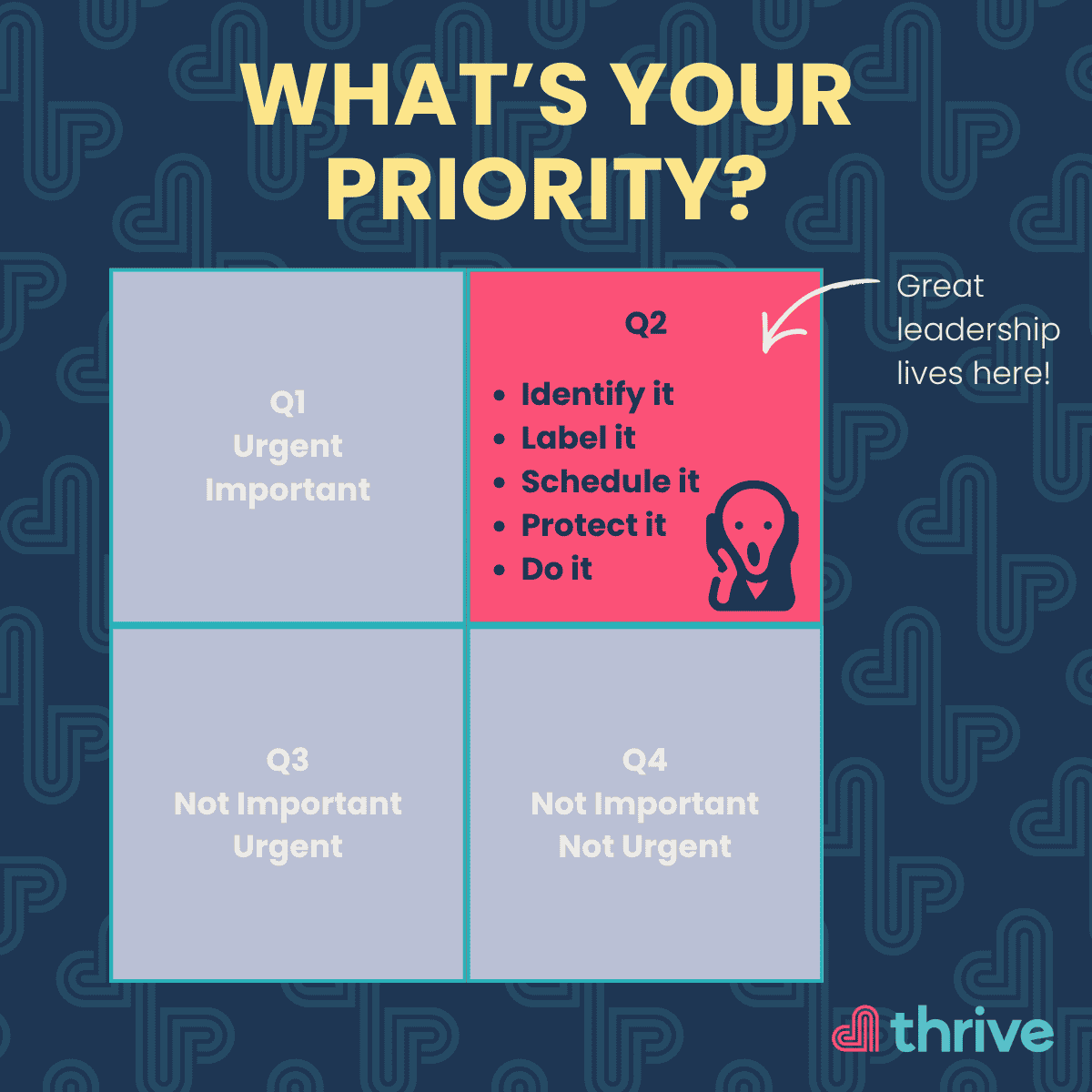
Quadrant 2 leadership
Picture Edvard Munch's The Scream. That's how important-but-non-urgent work tends to respond when it gets rescheduled again - silently screaming while everything else makes noise.
Covey called this "Quadrant 2" work: the activities that build capability, capacity and growth, and that create compounding returns over time. No one sets out to become the Accomplished Firefighter, prioritising urgent over important. We know better - we just don't do it, because Quadrant 2 work waits quietly while everything else loudly demands attention and feels more compelling.
If you want to put the firefighter's hat down and embrace Quadrant 2 leadership, here's where to start:
🎯 Identify it. If you could protect one Quadrant 2 activity right now, what would create the biggest shift for you or your team? Maybe it's the one-on-ones you keep rescheduling. The strategic planning session postponed twice.
🏷️ Label it. What value will that activity bring? Perhaps it is "Succession planning" or "Strategic progress" - specific language, not just "planning" or "flexible time". That specifity signals to others that the time is committed, and reminds you why it matters.
🗓️ Schedule it. Block it into your calendar at your peak performance time, using the label that represents its value.
⚔️ Protect it. Treat that block the way you'd treat your most important meeting, the one you'd never casually reschedule. When interruptions arrive either decline ("I have other priorities at that time"), defer ("I have a conflict, here's an alternative time.") or delegate ("Anna can take the lead on this for you").
Identify it. Label it. Schedule it. Protect it. Do it.
The strategic no
The ability to say no, to prioritise time and resources appropriately, is a core leadership skill.
However, it's one we rarely teach explicitly, despite almost half (49%) of Australian and New Zealand employees report experiencing ongoing feelings of burnout or exhaustion. According to Sonder's employee wellbeing research, the groups experiencing disproportionately high burnout are middle managers and female leaders, who often act as the "shock absorbers" absorbing additional workload that competes with their own priorities.
Saying yes to everything usually comes at the cost of Quadrant 2 work - the strategic thinking, relationship building, professional development and downtime that actually restores capacity rather than depleting it. In other words: saying yes to everything is actually saying no to the work that matters most.
At Thrive, we teach the Strategic No - a simple four-step framework that supports people to protect Quadrant 2 priorities without damaging relationships or triggering guilt:

- Pause first. Ask yourself: "Is this mine to own?" Not every urgent request deserves your yes - some belong to someone else's development.
- Respond with clarity. "I have another commitment" or "I have another priority" - without over-explaining or justifying.
- Offer an alternative. If it does belong in your wheelhouse: "I could help you Thursday afternoon." If not: "Can I suggest speaking with Anna?" Alternatives protect the priority while maintaining the relationship.
- Give thanks, not apologies. "Thanks for understanding" not "I'm so sorry." We give gratitude for someone's understanding, not an apology for having priorities.
The Strategic No protects what makes sustainable impact possible: your time, your energy, and your capacity to do the work that actually matters.
Sustain yourself to sustain it all
Identifying Firefighting tendencies, scheduling and protecting time for Quadrant 2 priorities and learning the art of the Strategic No are key practices to overcoming the urgent vs important trap. However, their effectiveness is dramatically diminished if you're running on empty.
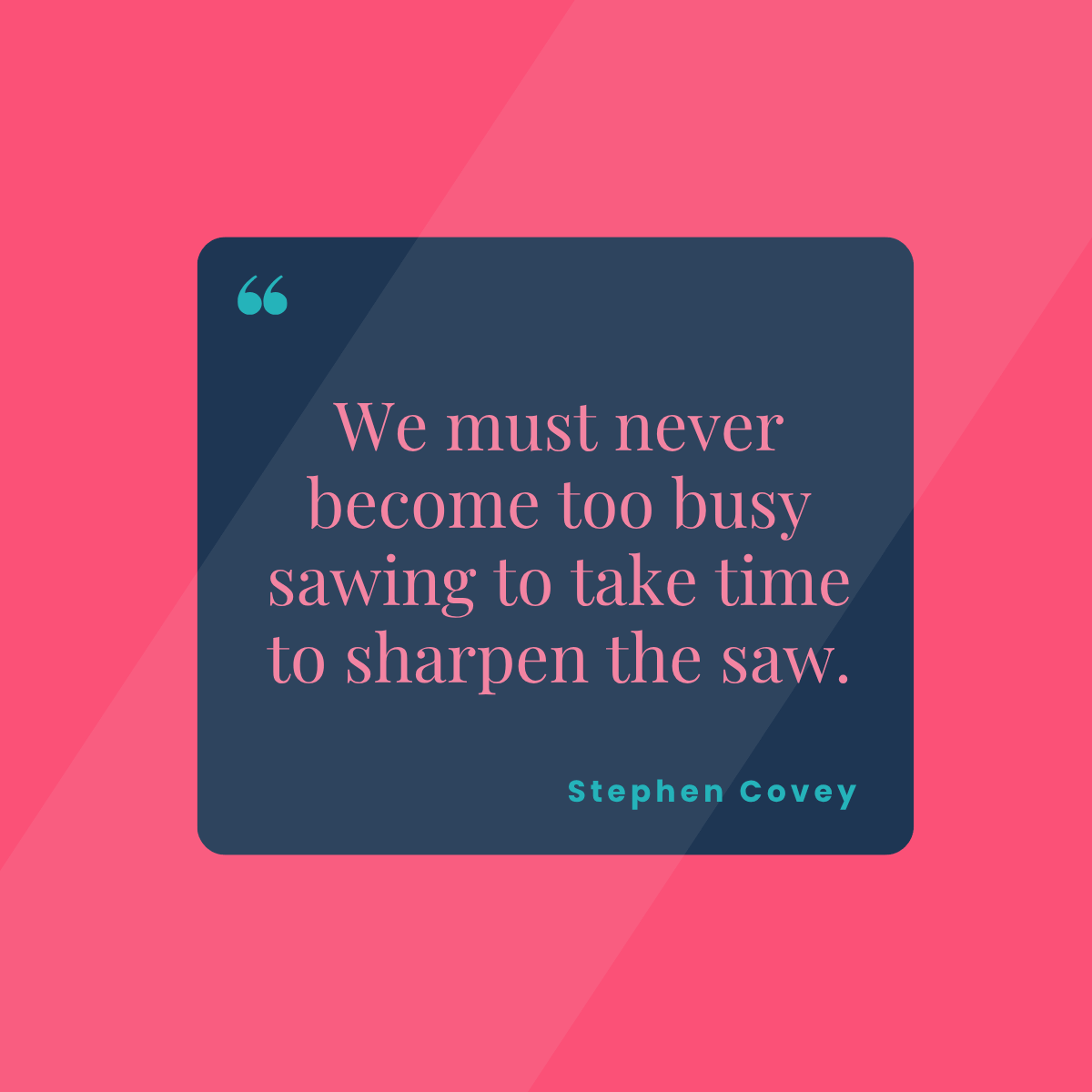
When we're physically exhausted, mentally overwhelmed, socially disconnected or spiritually depleted, our ability to lead ourselves and others diminishes. Instead of prioritising, we push and do more. Judgement suffers. Patience wears thin. Strategic thinking collapses back into reactive firefighting - the exact pattern we're aiming to interrupt.
In times of pressure and uncertainty, self-renewal is often the first thing sacrificed. We tell ourselves we'll rest when things calm down, and as a result deplete our energy further in the process. Sustainable leadership requires deliberate renewal across four dimensions - what Covey named the 7th habit, "sharpen the saw":
🫛 Physical renewal: rest, nutrition, movement, sleep. Our bodies are the foundation everything we do.
📖 Mental renewal: learning, reading, deep thinking. The mind needs challenge and recovery in equal measure.
👫 Social and emotional renewal: genuine connection, meaningful conversation, time with people who fill your cup.
💭 Spiritual renewal: reflection, gratitude, connecting with what matters beyond the immediate moments.
These aren't luxuries for when you can fit them in, they're the actions that allow you to show up for everything and everyone else.
To build your capability in this area, start small - identify one action of renewal you can take today. A 20-minute walk. A chapter of a book. A conversation with someone who energises you. Five minutes of reflection.
The Thriving Take-Away
Time scarcity is one of the greatest challenges facing today's leaders, and protecting time to do what matters most requires a conscious effort. Sharpening our saw enables us to make that effort, allowing us to recognise when we fall into the urgent vs important trap. Awareness provides the opportunity to break the pattern, and to start scheduling and protecting time for the "important". In doing so, we not only impact our own effectiveness but also role model the approach for our team to learn from. Practicing the Strategic No does the same.
The four elements together help us, as Leaders, to create a team environment that learns not only to respect time prioritisation but to celebrate the outcomes it produces.
What's Next
Protecting your time and energy isn't a one-time fix. It's an ongoing discipline, and like any discipline, it's easier to sustain with the right structure and support around it.
At Thrive – Do What Matters, we coach leaders to develop this capability: building the systems that protect what matters, so performance doesn't come at the cost of burnout to themselves, or their teams.
Book a free Discovery Call and let's talk about protecting what matters most in how you lead.
Frequently asked questions
What is the urgent vs important trap?
The urgent vs important trap is the pattern of consistently choosing loud, time-sensitive tasks over quieter but higher-value work, even when you know the important work would produce better outcomes. It happens because humans are naturally wired to respond to what demands attention right now, not what matters most long-term.
What is Quadrant 2 in the Priority Matrix?
Quadrant 2 refers to work that is important but not urgent - activities like strategic planning, relationship building and skill development. Popularised by Stephen Covey, it's the quadrant that creates compounding long-term returns but is usually the first to get bumped when something urgent arises.
How do I say no without damaging the relationship?
Use a four-step structure: pause and ask whether the request is genuinely yours to own, respond with clear language without over-justifying, offer an alternative time or resource if appropriate, and close with thanks rather than an apology. This protects your priorities while keeping the relationship intact.
Why can't I just push through and rest later?
It's tempting isn't it, and potentially Leaders can do it in the short term. However, continually pushing through depletes the physical, mental, social and spiritual reserves that good judgement, patience and strategic thinking depend on. Without deliberate renewal, leaders default to reactive firefighting rather than considered decision-making - the opposite of what sustainable performance requires.
What are the four dimensions of renewal?
Physical (rest, nutrition, movement, sleep), mental (learning and deep thinking), social/emotional (genuine connection) and spiritual (reflection and connecting with what matters beyond the immediate). Covey called deliberately maintaining all four "sharpening the saw."
SOURCES:
- Covey, Stephen; The 7 Habits of Highly Effective People
- Sonder Insights, Battling Burnout Guide